PAOLO'S HOME KIBERA NAIROBI
Physical rehabilitation services and a day center for children with psychological and neuropsychiatric disorders.



Funding Request 2020
To view and print click here.
Visit to Nairobi, January 14–18, 2019
To view and print click here.
Nairobi Project
To view and print click here.
Nairobi Project Update
To view and print click here.
Vellore, India
To view and print click here.
Report for 2017
To view and print click here.
TYPE OF INTERVENTION: Physical rehabilitation services and a day center for children with psychological and neuropsychiatric disorders
THE PROBLEM AND CONTEXT
Kenya has a population of nearly 50 million, with an average age of 19. Some 43.4% of people live below the poverty line. Legislation recently introduced to provide community-based mental health services does not reflect the reality on the ground: there are fewer than 100 psychiatrists in the entire country (source: WHO).
Likewise, the right of children with mental disabilities to inclusion in education, enshrined in national law, remains largely unfulfilled. The only public mental health services are provided by the large Mathare psychiatric hospital in Nairobi and three smaller facilities in other regions of the country.
In practice, however, only people who are employed and therefore have health insurance to cover the cost can access these services. Rehabilitation services for people with neurological disorders are insufficient and difficult to access. These problems are even more acute in a fragmented community such as Kibera, Nairobi, one of the most densely populated and poorest slums in sub-Saharan Africa.
Kibera’s population is difficult to count accurately but amounts to several hundred thousand people, at least half of whom are unemployed. Residents therefore live in extreme poverty, in small shacks, mostly made of sheet metal and separated by dirt paths, without access to essential services such as water and latrines.
Entire families live here, sharing cramped indoor spaces and outdoor areas with their neighbors in severely overcrowded conditions. The proportion of people with disabilities is high, owing to inadequate living conditions, scarce healthcare services, and a lack of preventive care. Superstition and prejudice also lead people to view disability as a curse or punishment for wrongdoing. When a child with a disability is born, the mother is often blamed, and the family, where one exists, breaks apart. The resulting stigma and isolation prevent the rights of people with disabilities from being respected.
CITTADINANZA’S RESPONSE: PAOLO’S HOME CENTER
Since 2013, Cittadinanza has supported Paolo’s Home, which assists children with physical and mental disabilities in Kibera.
Opened in 2008 by Koinonia, the center serves more than 150 children with conditions of varying origins and types: cerebral palsy, spina bifida, epilepsy, varying degrees of developmental delay, autism, Down syndrome, and brain injuries caused by meningitis or complications during childbirth.
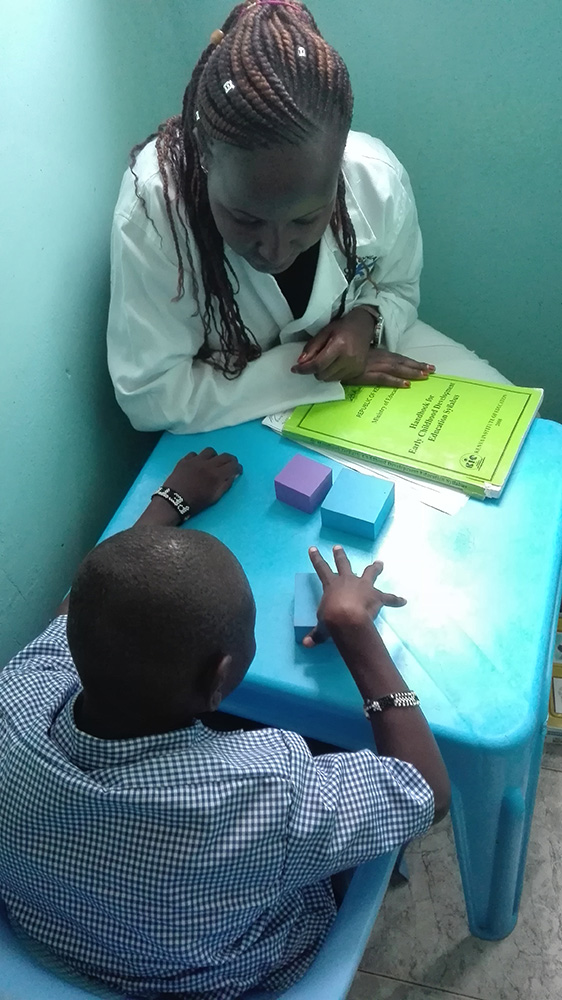
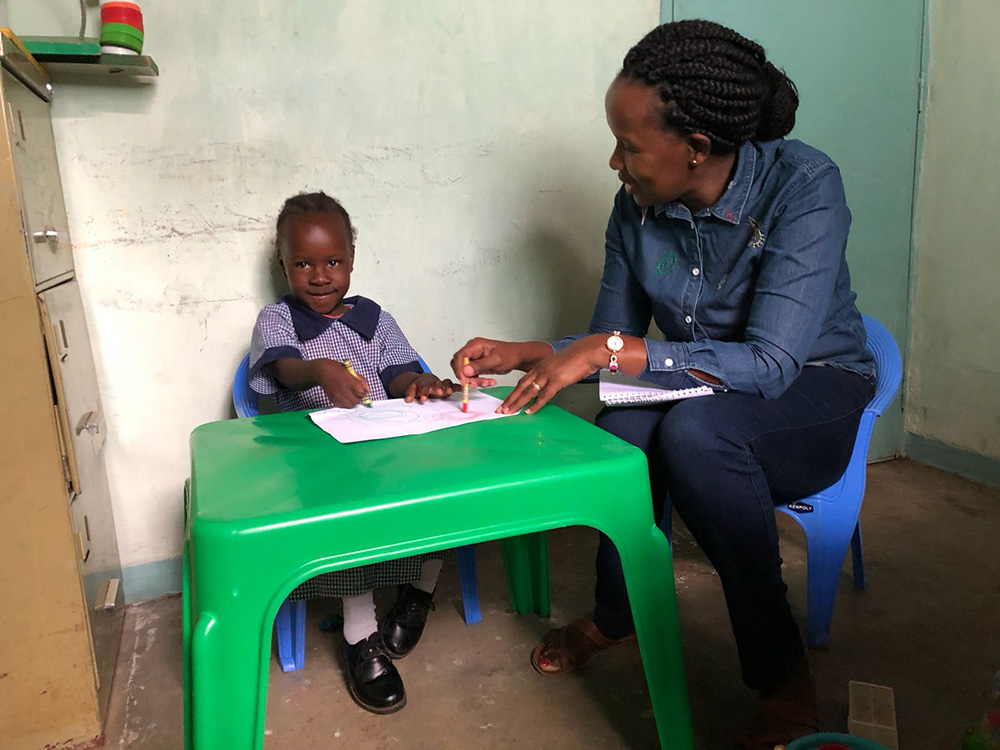
In 2013, a day center opened alongside the physiotherapy clinic. Each day, 15 children receive two full meals, educational activities, and physiotherapy through individualized programs with physical, cognitive, communication, and social goals.
Paolo’s Home has a multidisciplinary team of local professionals: two physiotherapists, a psychologist, an occupational therapist, a social worker, and two educators. They work at the center and also make regular home visits and conduct awareness-raising activities to engage the community and combat stigma, isolation, discrimination, and marginalization.
THE CENTER’S ACTIVITIES
Over the years, the project has expanded to include several complementary programs addressing the needs of the families who turn to the center:
PHYSIOTHERAPY PROGRAM
• Sessions at the center three days a week and home visits two days a week
PSYCHOSOCIAL PROGRAM
• Through group sessions and individual consultations, a psychologist provides young mothers—most of whom lack information about the causes of their children’s conditions—with information, awareness, and the psychological support they need
DAY CENTER
• Comprehensive care for 15 children, providing two nutritious meals every day, social activities, individualized educational activities, rehabilitation, and medical consultations
EMPOWERMENT PROGRAM
• Economic empowerment for mothers through vocational training, the production and sale of handicrafts, and revolving loans. Each month, two mothers take turns working in meal preparation and childcare, enabling them to participate actively in rehabilitation and giving all of them an opportunity to earn an income. The children’s parents, often single mothers, are involved in their children’s rehabilitation and receive individual and group psychological support from the center’s psychologist.
SUPPORT FOR SCHOOL INCLUSION
• Partnerships with schools in Kibera and coverage of part of the school attendance costs for some children with disabilities
HEALTHCARE SUPPORT
• Arranging and paying for specialist medical consultations at local healthcare facilities
AWARENESS-RAISING PROGRAM
• Community awareness through door-to-door campaigns and a march through Kibera on the International Day of Persons with Disabilities, held each year on December 3
WHAT’S NEXT: ACHIEVEMENTS IN 2017 AND FUTURE PLANS
Thanks to the contribution from Fondazione Irma Romagnoli, Paolo’s Home was able to continue its activities during a year of change. Fifty-two new children were registered, including following the relocation of activities to temporary premises to allow expansion work at the Karanja Road site. Progress on school inclusion was also positive: eight of the 15 children in the day program achieved their developmental goals and entered schools in Kibera in early 2018.
During 2017, around 116 children were reached through therapy sessions at the center, home visits, and day care. This was in line with the previous year, confirming the center’s good reputation within the Kibera community. Physiotherapy and occupational therapy sessions continued, reaching 50 patients each month, alongside home visits and daily support for children enrolled in the day care program.
The speech therapy service introduced in December 2016 continued despite difficulties caused by a shortage of trained professionals. Services for adults included psychosocial support reaching an average of ten people each month, an economic empowerment program, training and team-building workshops for parents, training for teachers from several local schools, and disability awareness activities for the wider community. There was also a significant increase in the number of people reached by Paolo’s Home’s awareness campaigns, to around 1,200. Door-to-door visits and three awareness events on the rights of children with disabilities helped identify children who were isolated from the community because of stigma and a lack of understanding.
The center’s range of services has grown steadily in recent years, but the available space is no longer sufficient to meet the community’s increasing daily requests for assistance. Funds for expanding the premises were therefore raised during 2017. Work will begin in the second half of 2018 and will double the space available for welcoming children and providing services. At the same time, Cittadinanza and ANSvi are strengthening relationships with key organizations involved in training physiotherapists, occupational therapists, speech therapists, psychologists, teachers, and other professionals caring for children with disabilities. A first training workshop will be launched in 2018, combining lectures with discussion of clinical cases from Paolo’s Home to attract more Kenyan therapists to the center. Research will gradually be introduced alongside training, in collaboration with the Speech Therapy program at Kenyatta University in Nairobi. With the Foundation’s help, we hope to respond to the appeal for support that Paolo’s Home sends us from the streets of Kibera.
CITTADINANZA Onlus – Registered office: Via Cornacchiara, 805 – 47824 Poggio Torriana – Operational office: Via Cairoli, 69 47923 Rimini · Tel/Fax 0541 412091 · info@cittadinanza.org · www.cittadinanza.org